
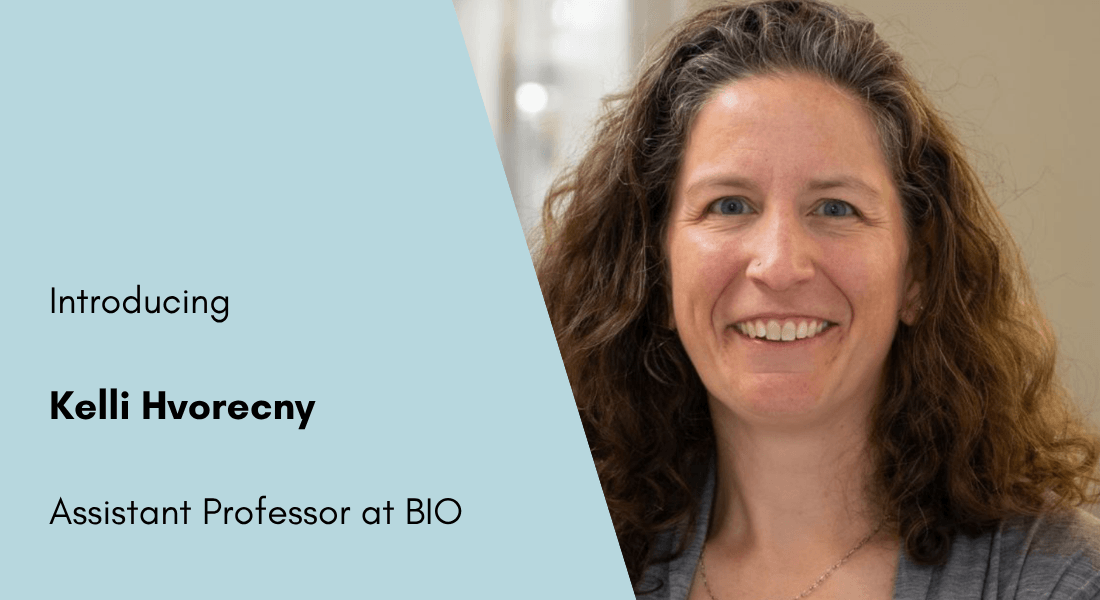
Introducing Kelli Hvorecny
Kelli Hvorecny is an Assistant Professor in the Department of Biology, Section for Biomolecular Sciences, at Kaj Ulrik Linderstrøm-Lang Centre for Protein Science and one of ISBUC’s newest group leaders. Her group combines techniques across multiple biological scales, including cryo-EM, cryo-ET, biochemical and biophysical assays, and tissue cell culture, to investigate how protein structure and function contribute to disease and shape species-specific biological traits. In this interview, Kelli introduces us to her research, shares her perspective on scientific collaboration, highlights potential projects for students interested in joining her group, and offers advice for early-career researchers.
What are the big research questions or research goals that your group is interested in answering?
I'm interested in the organization of metabolism. When cells were first discovered, around the 1850s, scientists at the time talked about them as laboratories, factories and kitchens. It's very much a description of something that's organized in a way to produce something. However, in order to figure out what was happening inside the cell, biochemists, chemists and biologists came along and lysed the cells, opening them up. They purified different components and identified the enzymes and the metabolites that are made by those enzymes that allow the cell to function. They defined the network of enzymes that produces metabolites, an important and impressive feat, but the result was very two-dimensional. You can't just take that two-dimensional network and put it onto a three-dimensional cell and say, "We figured out metabolism in the cell!”. So, what I'm interested in is how these pathways and individual enzymes are organized within the cell. Some of them are segregated into organelles, but many are just in the bulk compartment of the cytosol. Even within organelles, how are the soluble proteins organized? Recent work by cell biologists has shown that there are conditions where metabolic enzymes coalesce into non-membranous structures. We don't yet know much about the triggers of assembly and what assembly is doing for a cell, and that is particularly interesting to me. I’m also interested in how the organization modulates the activity of these enzymes. Does the organization allow the cell to allocate resources in one direction or another, and how does that happen at the different organizational levels? You can imagine that at the level of the enzyme, assemblies change the activity of the enzyme. How are these assemblies positioned in the cell, and does that matter? And furthermore, how do the assemblies allow for the cell to cope with environmental changes? How is that different among cell types? That includes different cells in the human body, but also all different life forms, since there's good evidence that these assemblies happen across the tree of life.
In the Nature Structural and Molecular Biology paper that you published in 2023, you determined the structure of the PRSP1 filaments in their active and inhibited states. Can you explain what you found and why having this understanding is important?
Looking at the big picture, we're thinking about how the cell is modulating metabolism. My example enzyme,phosphoribosyl pyrophosphate synthetase (PRPS), sits at a cellular decision point. It is at the top of the de novo nucleotide biosynthesis pathway, making it particularly important for nucleotide production in the cell. If the enzyme is turned on, then a lot of resources are being dedicated to nucleotide biosynthesis. If it is turned off, these resources will be cycled back into glycolysis and central metabolism, and they can be used elsewhere. This ability to control this enzyme allows a cell to control where resources are being allocated. Therefore, how this particular protein is being regulated in the cell seems quite important.
This study showed that the enzyme can assemble into filaments and the interface of these assemblies is the same between both the active and the inactive form of the enzyme in filaments. There are, however, differences in the oligomer organization when comparing the two structures which are important for activity and inhibition. Overall, the filaments pattern the allosteric site, where either the activator or the inhibitor bind, which suggests that filament assembly reinforces the active confirmation or the inhibited confirmation. If mutations in the interface are introduced, filament formation is broken up and catalytic activity is lost. These observations came together to suggest that enzyme assembly into filaments enhances catalytic activity by patterning the allosteric site.
Filament assembly, then, adds another layer of regulation where a cell can tune the amount of nucleotides being produced. This layer of regulation may also play a role in disease. Patients with mutations in PRPS present with a spectrum of disorders. On one end of the spectrum, there is overproduction of nucleotides, and that causes a buildup of uric acid in the joints. On the other end of the spectrum, there is a deficiency of nucleotides. Those patients present with neuropathies that can come in a variety of forms: hearing loss and vision loss, but also Charcot-Marie-Tooth disease or Art's Syndrome, diseases that present with motor or cognitive deficiencies. The fact that the enzyme gives you this spectrum of phenotypes when mutated suggests that the level of activity is very important for proper cellular function and that filament assembly is an important layer.
Based on this novel understanding, what research areas are you planning to explore further and why are they exciting?
I have three big aims at the start of my group. One of them is thinking about how environmental and cellular cues trigger assembly and disassembly of the protein within cells. There are many low-level, interesting questions to ask. We know very little about what triggers PRPS assembly in cells. We know that these assemblies exist; cell biologists have looked across different organisms, and we see them there, but what triggers them and why and when do they form? We also know very little about what the kinetics of formation and disassembly look like.
Another aim is thinking about the biophysical and biochemical properties of the filaments themselves and investigating how multiple regulatory mechanisms contribute to filament assembly and catalysis. In a cell, there are also other modes of regulation besides assembly. For example, there can be regulation via post-translation modifications. There are also transcription and translation as a regulatory module, and that's particularly important for PRPS because there’s not just one PRPS gene. Vertebrates have five PRPS genes. At least four of them are ubiquitously expressed across almost all tissues, but they're expressed at different levels. The last layer of this is that the interfaces are conserved. It seems quite likely that the enzymes could form different levels of hetero-assemblies, and recent cell-based work supports this. So, hetero-dimers, hetero-oligomers or hetero-filaments, in essence. There's a lot of interesting biochemistry and biophysics to pick apart there. Are there preferences for the pairings among the different gene products? How does each contribute to the sum of nucleotide production? What happens when mutations occur?
The third aim is thinking about how PRPS may be regulated differently depending on the organism. Vertebrates have five PRPS genes, but there's a large variety across eukaryotes. Prokaryotes generally only have one PRPS gene, but the filament assembly residues are not universally conserved. Perhaps we can leverage this information into new targets for potential antimicrobials. Targeting something that's important for metabolism is a great way to kill something, but it's got to be specific and different enough from humans to be a feasible target.
What structural biology techniques do you usually use in your research?
For me, the research question being asked usually dictates the techniques that are used. For the work that I plan to do, cryo-electron microscopy (cryo-EM) will very much support that. EM is my current favourite technique to apply. I love that in EM you're taking a picture of your protein, and you can see the protein. There's something about being able to see what you're working on, especially when you normally can’t. The nerdy scientist in me just loves that I can see the protein! With cryo-EM, we take a lot of pictures and we average them together to generate the volume that we can then use to build our model.
Do you have any advice for people at the beginning of their career?
Early on, I think it's really important to be open and flexible. That is at least what I did and I liked how that allowed me to try different things. I didn't know what I didn't know. Before my PhD, I didn't have a lot of experience with structural biology and what you can do with the kind of techniques that are involved. I am so glad that I rotated in a structural biology lab. I thought, “Wow, this is amazing”. I am so glad I didn’t do exactly what I had thought I would do when I came into my PhD program.
I think it’s important to say yes to things. You can’t say yes to everything, but say yes to some things where you're pushed a little bit out of your comfort zone. You might be surprised at what you enjoy and where that might take you. But it can be hard.
The other thing is to try not to take failure personally. There are many reasons why things can fail and not go how you had imagined in your mind. It's important to learn from it. If the reason why it failed is that it turns out that you pipetted something incorrectly, and you learned something from that, then great. Then you've achieved a goal and you can move on and build on that, which I think is the important part. A lot of scientists personally identify with the science that they're doing and they're very invested. So, saying yes to things outside your comfort zone means that sometimes things might fail, and that's part of the process.
Are there any openings for bachelor students, master students, PhD and postdocs?
I'm excited to work with Bachelor's and Master's students. I also think it's really great for PhDs and Postdocs to work with Bachelor's and Master’s students as it is great training on how to teach and mentor, which are skills important in most jobs. I'm planning on having some projects available for Bachelor's and Master's students in late 2027 or early 2028. But interested students can come talk to me and we can go from there!
What about senior researchers? Is your door open for collaborations?
I think there are great opportunities to collaborate with researchers here and it is one of the reasons I was excited about the position. For example, I would be happy to work with experts in small X-ray scattering (SAXS) and polymerization assays. There are also unstructured loops on a couple of the PRPS proteins, so I would love to tap into the IDR expertise here at KU. I would like to do some cell biology work, so having some advisors and collaborators would be extremely helpful. Don’t be surprised if I come find you for some advice! I would be interested in hearing collaborator thoughts on my project plans.
I would also say that if anyone is interested in collaborating because you think I can help you, please come talk to me. I'm happy to talk, even if it's just to throw some ideas around. I'm always interested in hearing what people are doing.
What would be some papers that you would recommend to people to read if they want to learn more?
Garcia-Seisdedos H, Empereur-Mot C, Elad N, Levy ED. Proteins evolve on the edge of supramolecular self-assembly. Nature. 2017 Aug 10;548(7666):244-247. doi: 10.1038/nature23320.
Noree C, Begovich K, Samilo D, Broyer R, Monfort E, Wilhelm JE. A quantitative screen for metabolic enzyme structures reveals patterns of assembly across the yeast metabolic network. Mol Biol Cell. 2019 Oct 1;30(21):2721-2736. doi: 10.1091/mbc.E19-04-0224.
Hvorecny KL, Hargett K, Quispe JD, Kollman JM. Human PRPS1 filaments stabilize allosteric sites to regulate activity. Nat Struct Mol Biol. 2023 Mar;30(3):391-402. doi: 10.1038/s41594-023-00921-z.
Hvorecny KL, Kollman JM. Greater than the sum of parts: Mechanisms of metabolic regulation by enzyme filaments. Curr Opin Struct Biol. 2023 Apr;79:102530. doi: 10.1016/j.sbi.2023.102530.