
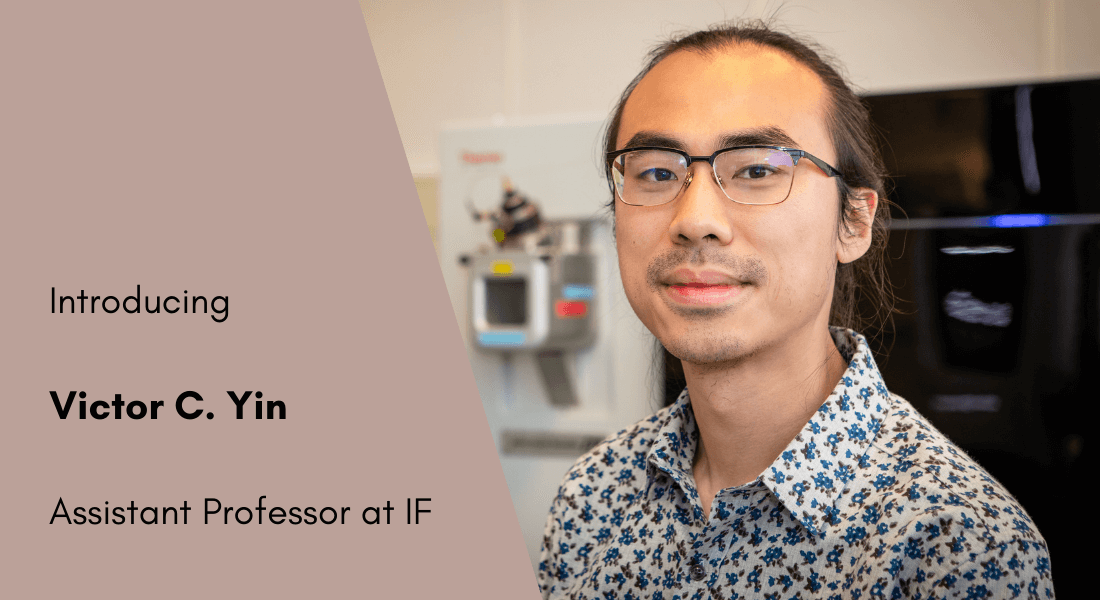
Introducing Victor C. Yin
Victor C. Yin is a tenure-track Assistant Professor in the Department of Pharmacy and one of ISBUC’s newest group leaders. Victor is a mass spectrometrist interested in developing technologies to help answer biological questions. He specializes in native mass spectrometry, which is a mass spectrometry-based technique used for studying intact proteins and their complexes. In this interview, he talks to ISBUC about the power of using mass spectrometry, science collaborations, advice for junior researchers and much more.
What do you love about mass spectrometry?
One of the strongest points of native mass spectrometry is that you're weighing proteins or protein complexes so mass spectrometry can answer questions related to the composition of the protein or protein complex.
Another thing you can tell very confidently is the stoichiometries, if you have a protein and you aren't sure if it's a trimer, tetramer or a pentamer. Oftentimes, biochemists will use size exclusion chromatography to figure these things out, but oftentimes your peaks are broad, or your retention times are not conclusive enough. This is where native mass spectrometry really shines because each of those things give a characteristic mass, so we can very confidently say if a protein is in a particular oligomeric state. Mass spectrometry is also well suited for studying post translational modifications, which other techniques don't handle very well.
However, many people would argue that mass spectrometry doesn't even count as a structural biology technique because you don't necessarily get a structure in the sense that we often think about structure. We don’t get high-resolution three-dimensional structures, like a PDB structure. But what I can tell you are the exact proteins that make up your complex, even if they’re dynamic or partially occupied. So in that way I think mass spectrometry is complementary and orthogonal to other structural biology techniques. We look at the same systems in different ways, which I always found interesting.
What can mass spectrometry do that other methods can’t?
If you think about drugs from 100 years ago, they're all small molecules like paracetamol, which are quite easy to characterize. Over the last 10, 20 years or so, biologics have become more relevant as a treatment. Now we're talking about proteins like insulin, antibodies, gene therapy vectors and mRNA vaccines. These molecules are much more complex than the small molecule drugs that we used to study. We need better methods as analytical chemists to be able to characterize them, and this is where mass spectrometry and native mass spectrometry play a key role. A lot of my previous work was using mass spectrometry-based methods to characterize gene therapy vectors like recombinant adeno-associated viruses. These large virus-like particles are millions of Daltons big, so thousands or more than thousands of times bigger than the small molecules. But by using mass spectrometry, we can determine a lot of things about them that's hard to do with other techniques.
If I use the example of the gene therapy vector, it's a virus-like particle that's made of proteins and DNA inside which is therapeutically useful. Imagine I work at a pharmaceutical company and I've made a whole batch of these, how do I know that my batch is good? You can test the activity, but that doesn't really tell you about its purity. Or, imagine I am a safety regulator and wanted to know how many particles are correctly assembled with the correct gene product. There are not many techniques that can tell you this! For example, electron microscopy can tell you that your protein particles have correctly assembled, but it is quite bad at telling you if the DNA is present inside. On the other hand, you can run gels to determine the total DNA or protein content, but that doesn't tell you anything about if the vector is assembled correctly. You could have a whole bunch of DNA just floating around instead of being inside the particles! Native mass spectrometry is unique in that it's really good at answering these compositional questions. If my resolution was high enough, I can take the particles, weigh them and tell you exactly from its mass that this particle is the right mass with the right particle on the outside, and I also know that it's the right gene inside.
Are you open for new collaborations?
I think collaboration is the best way to do science. By working together, we bring the best of all worlds. I've collaborated with electron microscopy people before, I've worked with an X-ray crystallographers, with NMR spectrometrists... This is how I've always worked throughout my scientific career. This is why I really like the whole collaborative network of ISBUC. Since I've started, I've got a really warm welcomes from PIs in ISBUC, so we already have a few collaborations with some of the ISBUC members. If anyone thinks that native mass spectrometry could be useful in their work, I'd be happy to chat.
Do you have any advice for those that are at the beginning of their career?
Speaking from my own experience, I think it's important to never be afraid to ask dumb questions. This is something that I learned early on. One of my very first projects during my PhD was supposed to be really straightforward: I was supposed to study a model protein (cytochrome c) that people have studied for 30 years. I ran an experiment to measure its mass, but I noticed that some of the masses were a tiny bit off from what they were they were supposed to be. I asked my PhD Supervisor, “Is this normal?”. He said “No, that's not normal, but people have been studying cytochrome c for 30 years so you probably just did something wrong”. Which is fair, but for whatever reason, it was really bugging me so I started to dig a bit further and explore some hypotheses of why it would be wrong. This whole thing blossomed into what end up being my PhD thesis, where I discovered new post-translation modifications in this protein that people had missed for 30 years. Mainly because the post-translational modification that we found only gave a mass shift of one Dalton, so it's a very minor change. Through functional assays we managed to show that it had huge implications on the function and the catalytic cycle of the protein. Just because something's been out there forever doesn't mean that we fully understand it. I think it's important for researchers to always be curious and question the dogma.
What would be the three papers that you would recommend to people to read if they want to learn more?
Deslignière E, Rolland A, Ebberink EHTM, Yin V, Heck AJR. Orbitrap-Based Mass and Charge Analysis of Single Molecules. Acc Chem Res. 2023 Jun 20;56(12):1458-1468. https://doi.org/10.1021/acs.accounts.3c00079.
Yin V, Devine PWA, Saunders JC, Barendregt A, Cusdin F, Ristani A, Hines A, Shepherd S, Dembek M, Dobson CL, Snijder J, Bond NJ, Heck AJR. Stochastic assembly of biomacromolecular complexes: impact and implications on charge interpretation in native mass spectrometry. Chem Sci. 2023 Aug 17;14(35):9316-9327. https://doi.org/10.1039/D3SC03228K
Yin, V., Shaw, G. S., Konermann, L. Cytochrome c as a Peroxidase: Activation of the Pre-catalytic Native State by H2O2-Induced Covalent Modifications. J. Am. Chem. Soc. 2017, 139: 15701-15709. https://doi.org/10.1021/jacs.7b07106.