
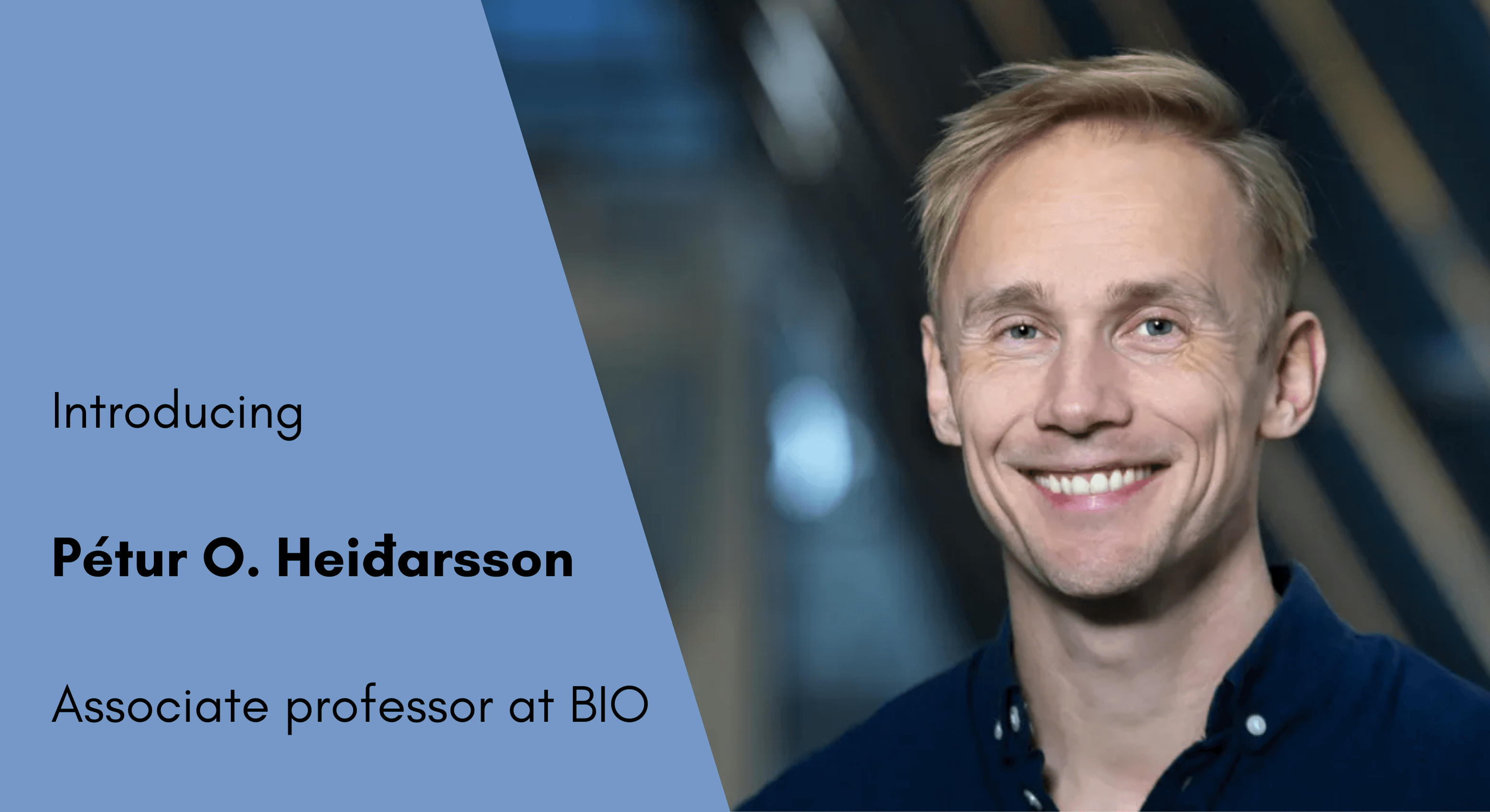
Introducing Pétur O. Heiðarsson
Pétur O. Heiðarsson, from the Department of Biology, is one of ISBUC’s newest group leaders. In this interview he talks to ISBUC about his research on transcription factors, the process about getting an ERC grant, advice for junior researchers and much more.
What are the big questions your research explores?
The big, big, big question that we're trying to answer is how do cells make decisions on a molecular level? That's the decision of for example changing from a stem cell into any other cell. How is that process and that decision made, and what are the molecular drivers (the transcription factors) that decide that a stem cell becomes a heart cell or a neuron. It's that whole process that we're trying to figure out.
It turns out that transcription factors, such as those that decide cell fate, are very disordered, which makes them super challenging to understand. Most of the transcription factors that we're working on have both structured and intrinsically disordered regions. The structured regions are the ones that recognize a specific DNA sequence. They find the location in the genome, which could be an enhancer, or promoter, or a gene itself and once they find the location in the genome, the disordered regions are responsible for recruiting other factors needed for transcription: it could be a chromatin remodeler, other transcription factors, or something else. There are multiple new functions that are emerging in this process. For example, these regions don't just activate transcription but they probably guide the protein to the correct site and change the environment around it by, for example, unwrapping DNA that's been condensed so that it becomes more accessible to other proteins. That's one of the properties that we're trying to figure out.
The other question we are interested in is: Can we use these factors to make cells take decisions, so that we instill a molecular decision into a system? And can we have control over this process by manipulating the proteins or tweaking them in ways that make them more efficient?
What techniques do you use to study transcription factors?
Single molecule techniques are really perfect for studying transcription factors because they are one of the few methods that can give you an almost instantaneous snapshot of a structure of a protein, especially when that same protein doesn't have a fixed structure. If it's undergoing dynamics between multiple different structures, especially in a disordered region, there is not really a good method for capturing the multitude of structural states that can form. Single molecule Förster resonance energy transfer (FRET) is a method that can, in principle, take a really quick snapshot of each one of those and when we use distance and dynamics information from single molecule FRET and combine it with computational approaches, we can build dynamic models of their structures. The models that we build are not static, but they're dynamic, so we can build movies of how they move and how their movements change when they bind to binding partners or when they engage with the genome. We're trying to get a sort of a moving picture of their function starting from their search for correct binding sides, when they’ve found their binding sites, and how they then activate transcription.
The other advantage is that, as the name suggests, it's a single molecule technique and that means that even when you have very complicated samples, you can still identify all the different populations that are in there, because you're measuring at a single molecule at a time. That's really where the power of this method lies. Another thing is that this allows you to, in principle at least, detect very rare events and rare events are often what really characterizes the function of a protein. You can also use really low concentrations of your proteins, which is another strength of this method. It's very sensitive, so that also means that you can in many cases circumvent aggregation. Transcription factors tend to aggregate a lot because they are so disordered, and so our approach of using single molecules allows us to go down in concentrations, which makes it possible for us to study a much wider array of systems that you might not be able to study with other methods.
You recently received a large infrastructure grant from Carlsberg Foundation to buy a new instrument. Can you tell us about this instrument?
The Carlsberg Grant allowed us to buy a instrument to do the single molecule experiments. It's called the Luminosa. This is a confocal fluorescence microscope that is really sensitive. It can detect single photons, allowing us to detect signals from individual molecules. It's the state-of-the-art instrument for doing these kinds of experiments. You can do FRET, you can look at proteins, DNA or any molecule, how they diffuse, you can look molecular movements across wide times scales. So going all the way from picoseconds, something that's really short, up to hours for that matter, if you're looking at something that is slow like aggregation. There's also imaging possible on this instrument, for example fluorescence imaging of even cells and so there are a lot of possibilities. It has multiple lasers, which allows us to have flexibility with the fluorophores that we use, so we can have multiple different fluorophores, for that matter. It´s a fantastic machine that is the core instrument in our lab and we use it for all experiments.
I’m always open to people using the technique and always open to collaborations. We're already collaborating with a lot of people within ISBUC and we are open to collaboration with just about anybody who is interested. On my website, there is a description of the instrument, and of the possibilities, so anybody who's interested can contact me for this.
Another grant that you got was the ERC grant. That's quite a big achievement. Can you tell me a bit about the process of getting that?
ERC grants involve really big applications, so the idea needs to be well developed. I wouldn't say that this is one of these grants that you go out on a whim in a short amount of time. I'm sure you can if the idea is good enough, but at least for me, these were ideas that had been brewing for a few years.
The most important thing for the ERC grant is the potential for big change, the potential for something really big coming out of it. I think making an evolving project that starts out with some feasibility and then becomes increasingly risky and explorative is a good strategy. It's all about balancing risk and reward, but going more towards the risky side of things, I would say. I think many have ideas that would be feasible for this but maybe think that these grants are too big and out of reach. But I think people should just go for it and try. You will never know unless you try!
The documents that you prepare are also quite extensive. There are essentially two applications, you make a short one and a longer more detailed one. You have to submit both, but in the first round, only the short one is looked at. If you get through the first round, you're invited for an interview. The writing and the budget making for the application was a lot of work. We got through the first round and then you get to an interview where you have a strict 10 minutes to present your idea followed by questions from the panel and these are very critical. This was online and I think there were about 15 panel members there. That's one of the most crucial points that needs to be really well prepared, and you need to be prepared for the questions that come up in that. That was a stressful event to go for, but it went really well and it taught me a lot. If anybody is going through an interview, I'd be happy to help and they can contact me.
Do you have advice for those who are just at the beginning of their career?
I would say adopt a growth mindset as early as you can. A growth and learning mindset where you take failures as necessary positives along the way and you try to grow and learn from the multiple failures that will come along your path in science. This is one of those things that is important to accept and understand that it's part of the journey. It can be mentally tough to go through failures because we're failing all the time when we're in science. We're working at the edge of human capacity and knowledge, performing experiments that often don't work until they do, and it's the growth aspect of the whole thing that is important to keep in mind.
The other thing that I was told very early in my career is that networking is really important. I did that as much as I could, but I didn't realize exactly how important it was until I got here. I see and am very grateful for the vast network that I have today, which wouldn't have really come about unless I had started networking early and slowly over time, so I do take every opportunity to connect with other scientists.
What would be the three papers that you would recommend to people to read if they want to learn more?
Bjarnason S, McIvor JAP, Prestel A, Demény KS, Bullerjahn JT, Kragelund BB, Mercadante D, Heidarsson PO. DNA binding redistributes activation domain ensemble and accessibility in pioneer factor Sox2. Nat Commun. 2024 Feb 16;15(1):1445. doi: 10.1038/s41467-024-45847-2.
Már M, Nitsenko K, Heidarsson PO. Multifunctional Intrinsically Disordered Regions in Transcription Factors. Chemistry. 2023 Apr 13;29(21):e202203369. doi: 10.1002/chem.202203369.
Zaret KS, Carroll JS. Pioneer transcription factors: establishing competence for gene expression. Genes Dev. 2011 Nov 1;25(21):2227-41. doi: 10.1101/gad.176826.111.